Safer entrances and lots for the people who work nights.
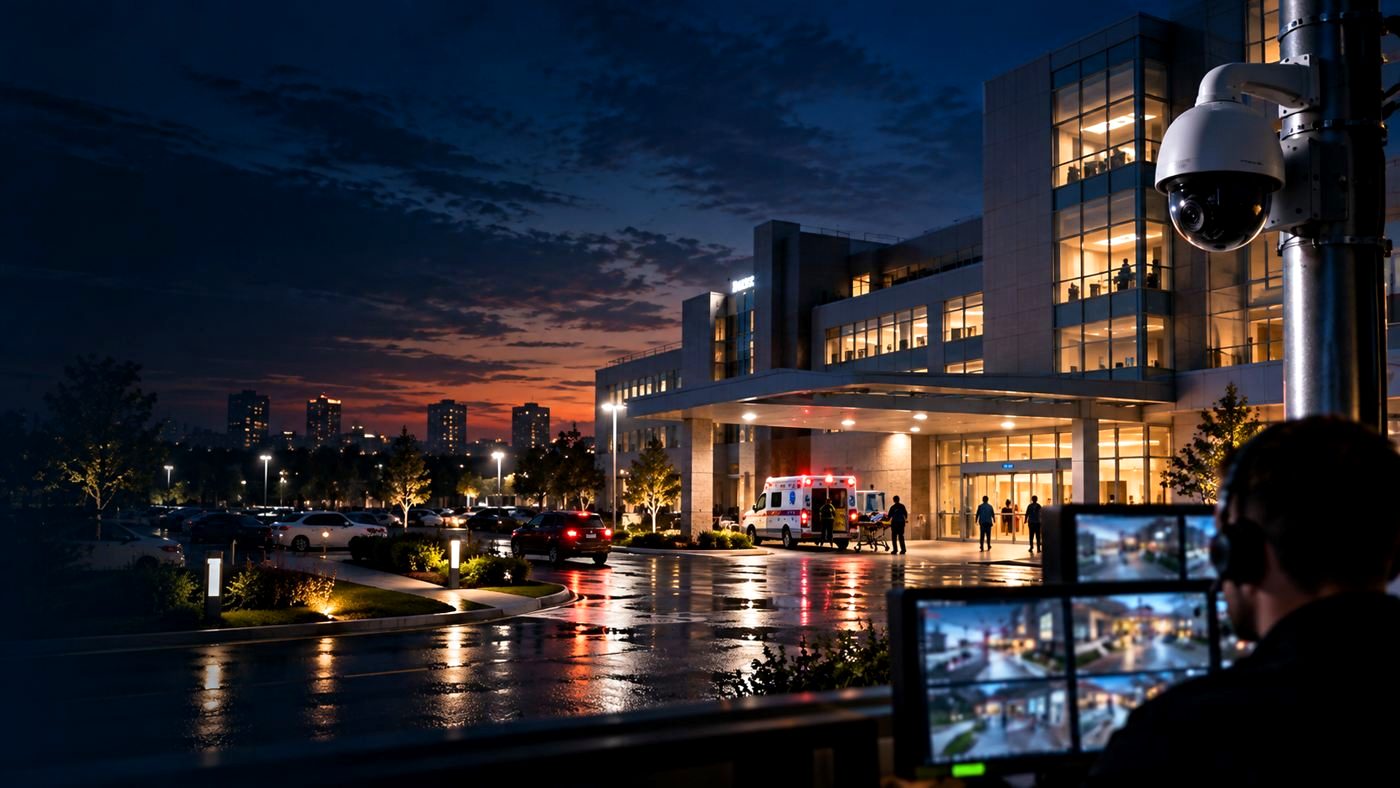
Clinics, medical office buildings and outpatient centers face a specific set of problems after hours: loitering at entrances, pharmacy and supply theft, and staff walking to their cars alone. We monitor the public-facing areas and lots, with coverage designed to respect patient privacy.
What healthcare operators ask us to solve
Visible, preventable and almost always outside the building.
Entrance loitering
Individuals camped at entrances and ambulance bays, deterring patients and staff.
Parking-lot safety
Night staff walking to distant spaces; vehicle break-ins in the far rows.
Pharmacy & supply theft
Pry attempts on pharmacy and supply doors, and deliveries left at loading areas.
Vandalism & copper
Rooftop HVAC copper and exterior damage at buildings that are empty overnight.
How we cover a healthcare site
Entrances, lots and service areas — never treatment spaces — with a staff-safety protocol.
- Entrance and ambulance-bay dwell alerts with courteous audio
- Virtual escort: staff call the center and an operator watches them to their car
- Lot zones with loitering, crouch and group-movement rules
- Pharmacy, supply and loading-door approach zones after hours
- Clinical and patient areas excluded by design; written privacy policy provided
Sample layout — your plan is drawn from a site walk and your existing camera positions.
An evening at an outpatient center in Mid-City
Entrance and lot zones arm; loading door confirmed closed. Operator notes a person seated at the entrance.
Subject has not moved in 20 minutes. Courteous audio request; subject leaves. Logged for the facilities team.
Nurse calls the monitoring center before walking to row F. Operator tracks her on two cameras until her car exits the lot.
Dwell alert verified on live video — one with a pry bar. Live warning naming their clothing; both leave on foot. Patrol dispatched; door undamaged.
VSS response unit walks the loading area and roof ladder; photographs sent. Facilities manager texted.
Four events, two interventions, one escort, one recommendation: motion lighting at the loading door.

What we usually deploy at healthcare facilities

AI Video Monitoring
Proactive, 24/7 monitoring of your existing cameras with AI detection and a human operator behind every alert.
Explore service
Virtual Security Guard
A remote guard presence: scheduled virtual patrols, live two-way audio and escorted access — without a posted officer.
Explore service
Incident Response & Dispatch
A written escalation ladder for every site: audio warning, mobile response, standing officer, police — executed by operators, documented for you.
Explore service
Camera Health Monitoring
Continuous checks on every stream — offline cameras, blocked or blurred views, night-time failures — ticketed and fixed before they become blind spots.
Explore serviceHealthcare Facilities monitoring FAQ
We monitor only exterior and public areas; no cameras in clinical or patient spaces are connected. We sign a BAA where required and keep a written access and retention policy.
Staff call the monitoring center, give their name and destination, and an operator watches them on camera until they are safely in their vehicle and off the lot.
Yes. Campuses are monitored as one program with per-building contact lists and response rules.
Get a flat monthly price for your property.
Send a site address and a camera count. We come back with a coverage map, a recommended program and pricing — usually within one business day.
Tell us about your site
Sent to info@virtualsitesecurity.com · We reply within one business day. No obligation.
Make the walk to the car the safest part of the shift.
Send your campus plan and shift times for a healthcare monitoring quote.