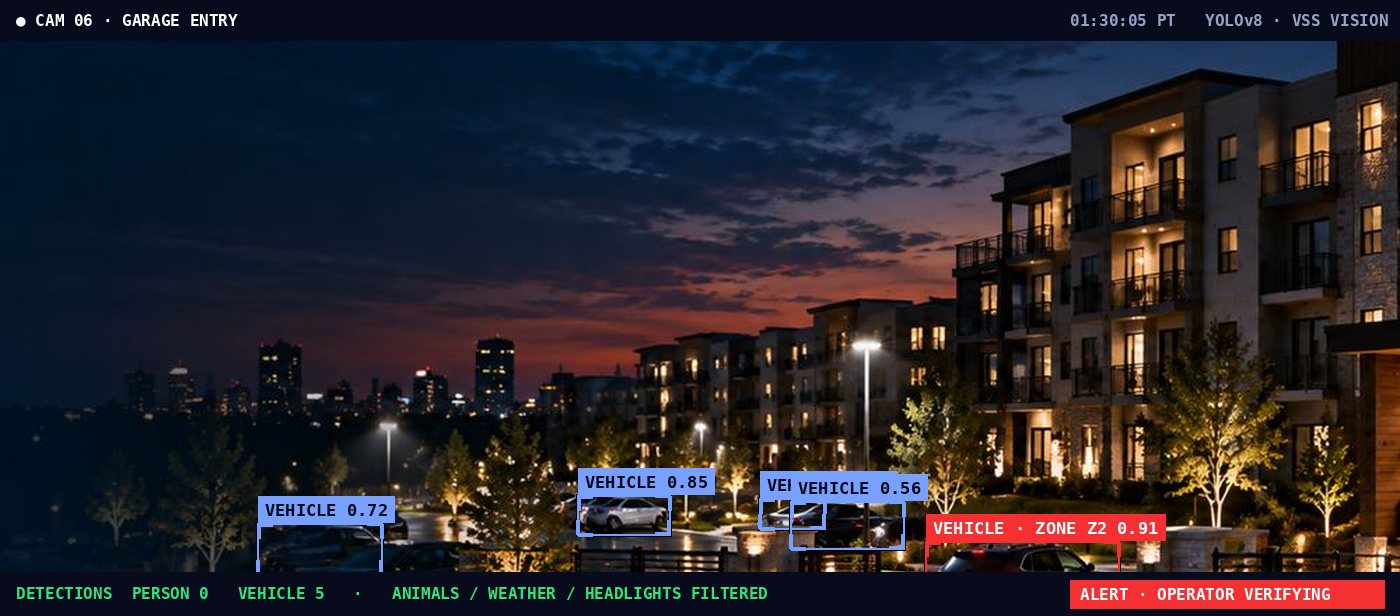
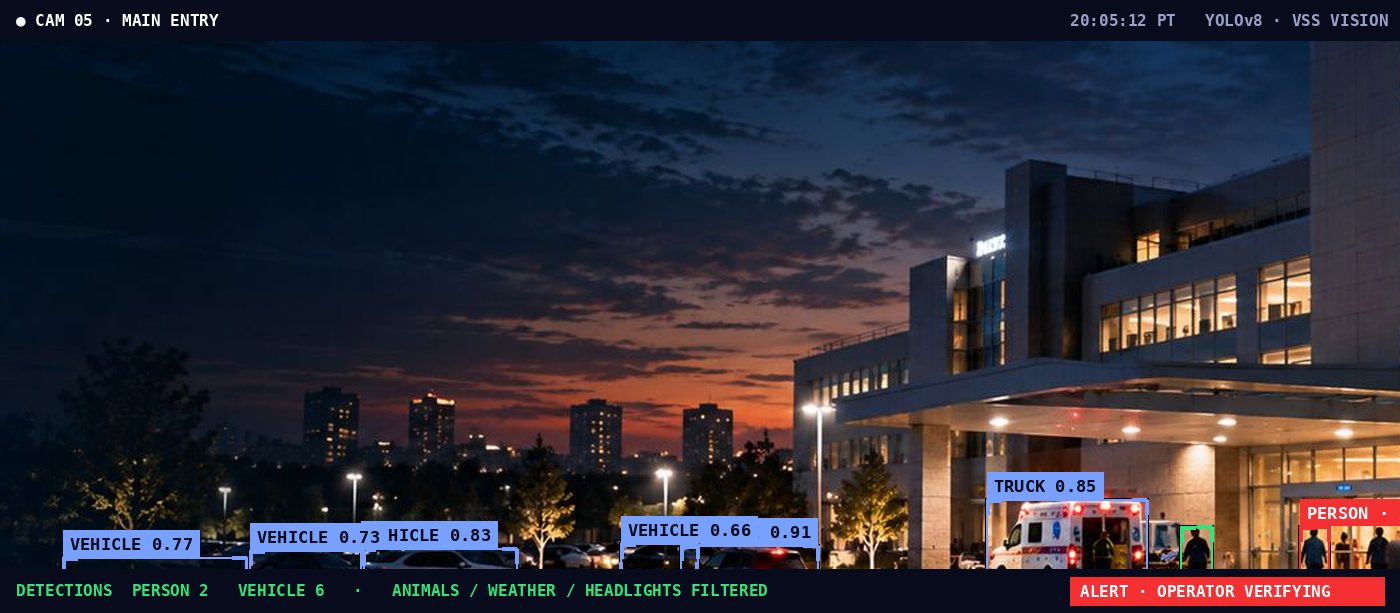
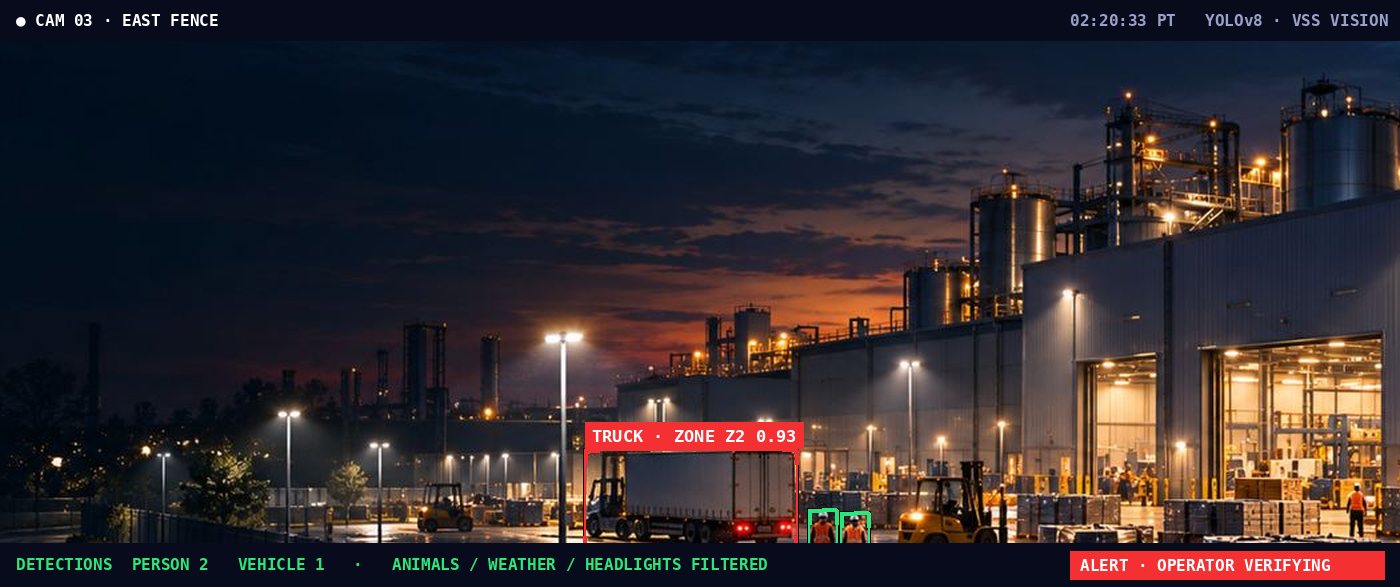
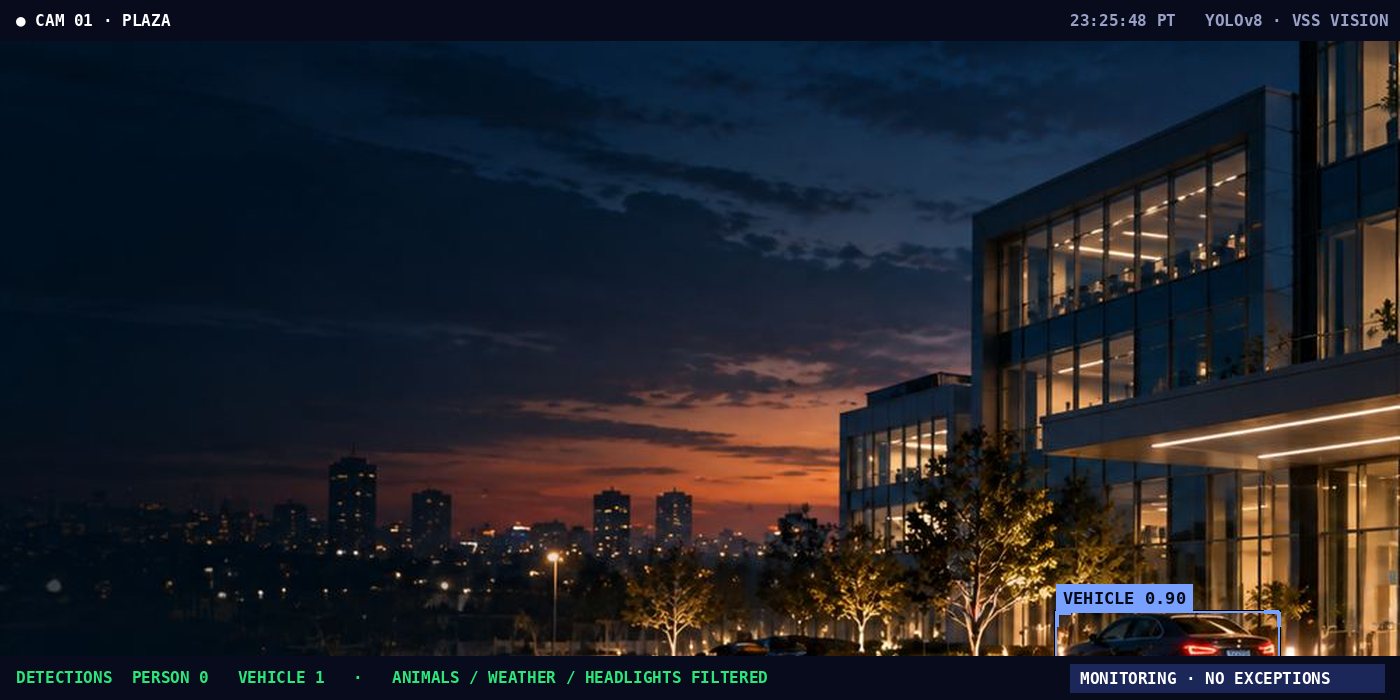
Virtual Sites Security runs a YOLO-family object-detection model on every monitored camera stream. These frames are real model output on night scenes — people and vehicles boxed with confidence scores, weather and lighting ignored, and one event escalated to a live operator.
The model does the looking; our operators do the deciding.
1 · Classify every frame
The detector scans each camera several times a second and labels people, cars, trucks and motorcycles with a confidence score. Trees, rain, animals and headlight glare produce no label — so they produce no alert.
2 · Apply your zones & schedule
A detection only matters where and when you said it does: inside the fence after 8 p.m., at the dock after the night shift, never on the public sidewalk. Zones and arming schedules are drawn with you during setup.
3 · Operator verification
Every zone hit opens the live stream on an operator desk in Los Angeles. The operator confirms what the subject is doing, speaks through the on-site speaker and dispatches response — the model never acts alone.
Live model output
Real detections on eight night scenes.
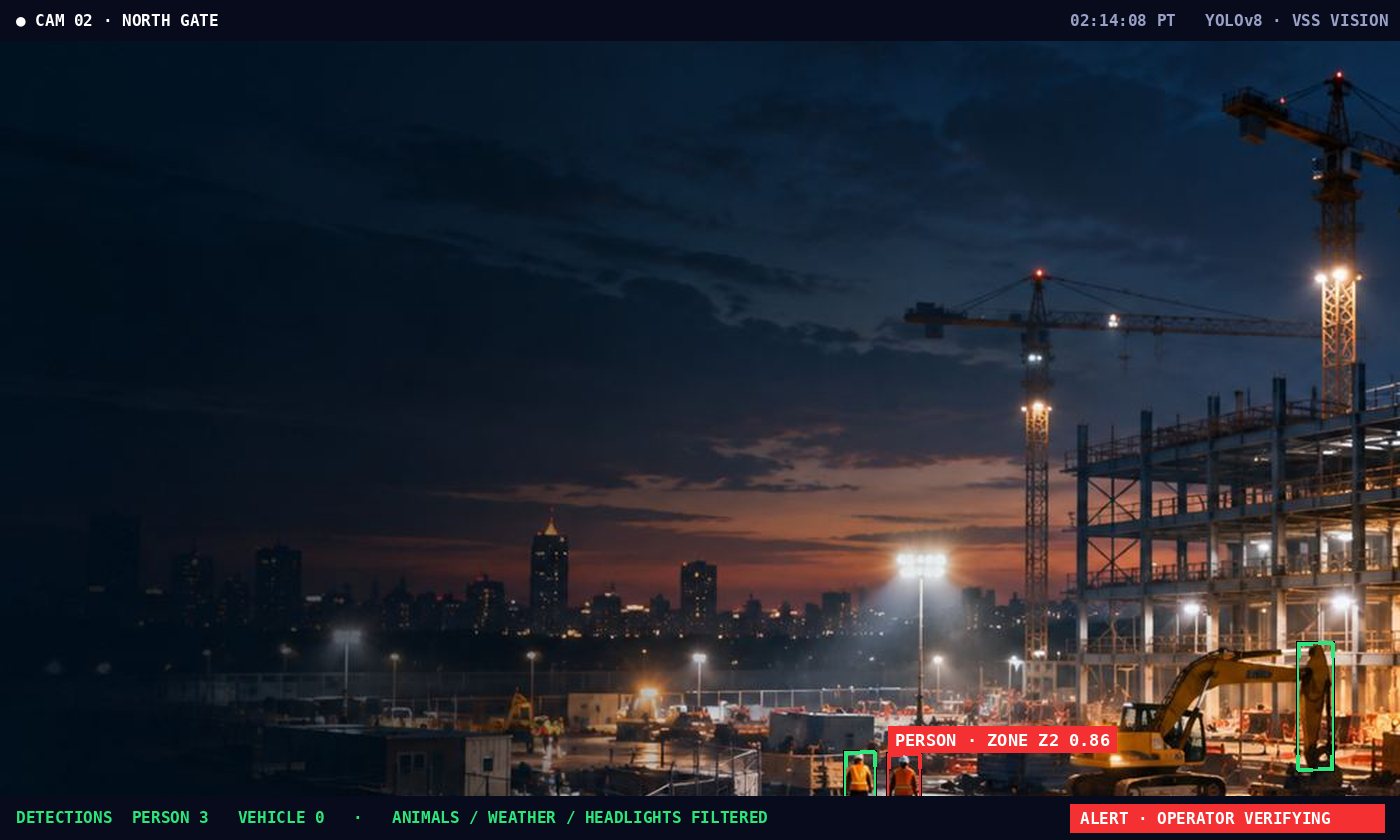
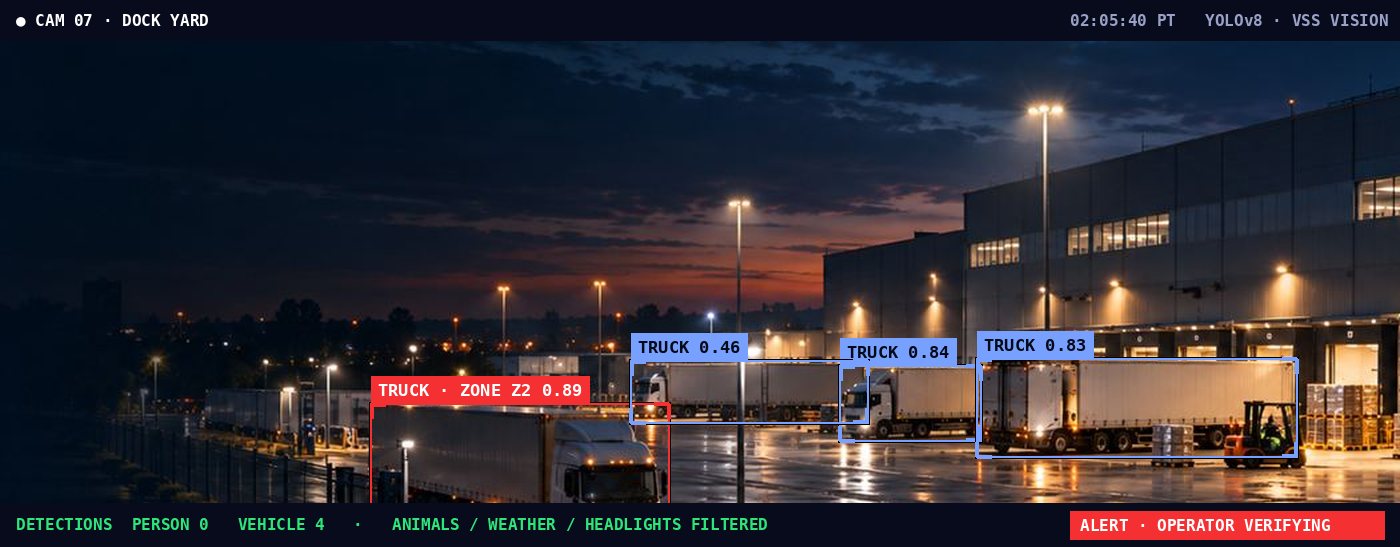
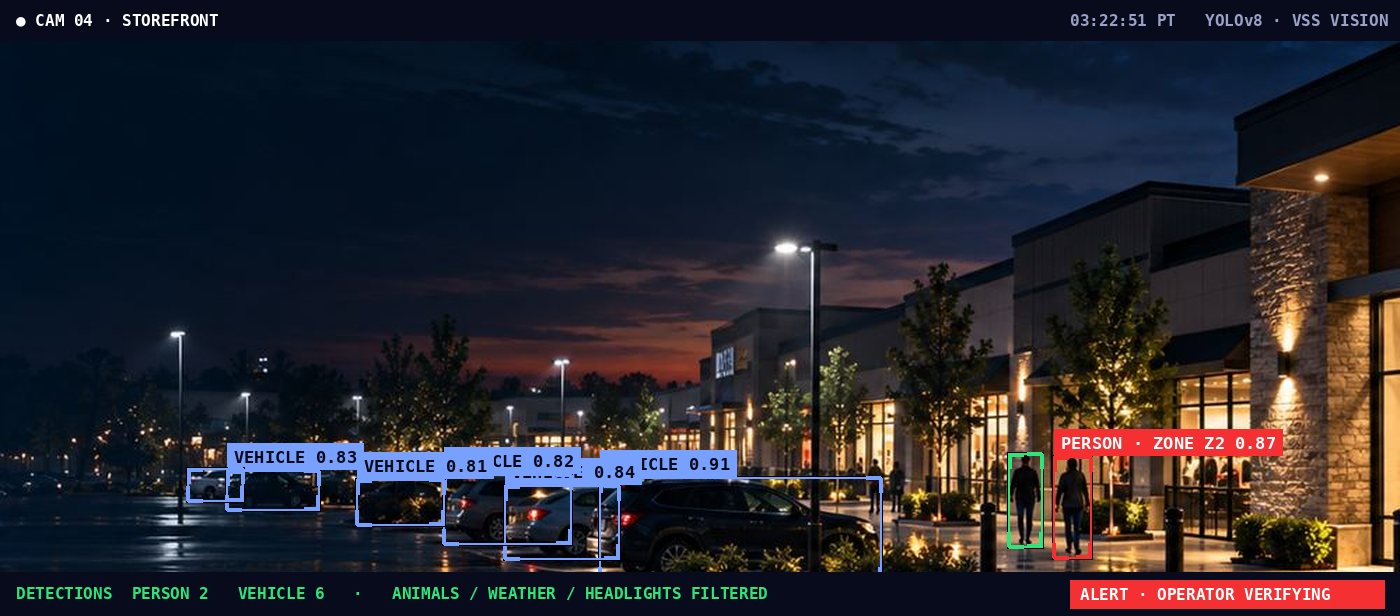
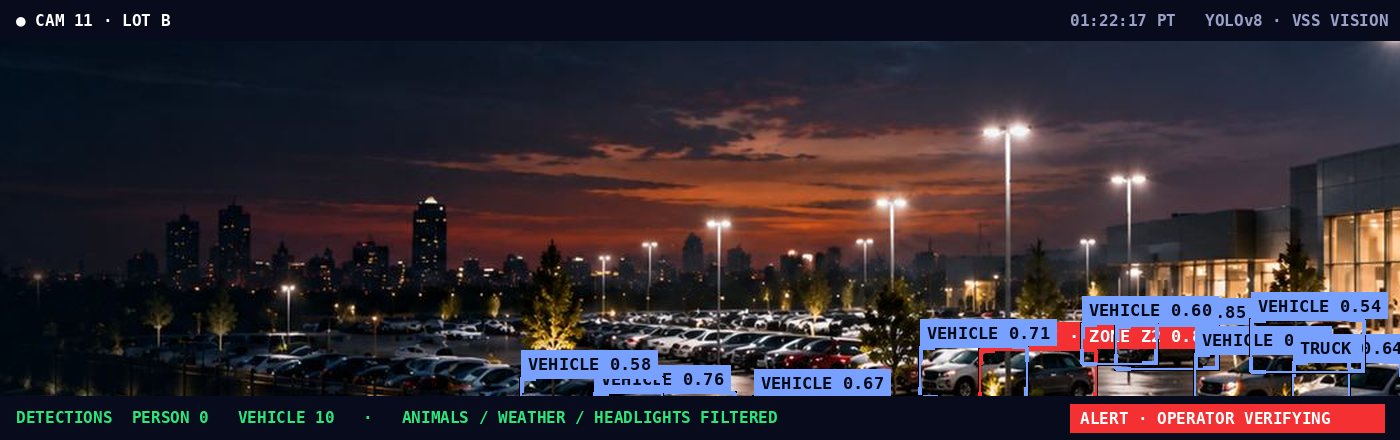
Green and blue boxes are classified objects with the model's confidence score. The red box is the detection that crossed an armed zone and was sent to an operator.
Construction site · North gateThree people detected inside the laydown yard after hours; the first zone hit (red) is escalated to the operator desk.Distribution yard · Dock sideTrailers parked along the dock are tracked individually; a tractor stopping in the trailer row outside its appointment window triggers a vehicle-dwell alert.Retail center · StorefrontPeople and vehicles are separated along the walkway and lot; a person lingering at the storefront after closing becomes the zone event.Dealership lot · Lot BDense inventory rows are handled without confusion — every vehicle is boxed, and a vehicle sitting in the overflow row is flagged for review.Apartment community · Garage entryVehicles approaching the garage gate are tracked for tailgating; the car waiting in the entry lane is the zone event.Healthcare campus · Main entryEntrance and ambulance-bay activity is classified continuously; a person loitering at the entrance after hours is escalated.Industrial plant · East fenceA truck stopping against the fence line after the second shift is flagged as a perimeter zone event.Office property · PlazaA single person crossing the plaza toward the lobby after the desk closes — one event, one operator review.
Specification
The detection pipeline, in plain terms.
Everything below is configured per camera during the two-night shadow-mode test, so thresholds match the lighting and traffic at your site.
Model family
YOLOv8 (medium), fine-tuned for low-light scenes
Classes escalated
Person, car, truck, bus, motorcycle
Classes ignored
Animals, vegetation, weather, shadows, headlights
Confidence threshold
0.45 default; tuned per camera
Zone rules
Intrusion, line-cross (directional), loiter / dwell, crouch, group
Inference location
Edge appliance on site or VSS cloud — no change to your cameras
Thermal support
Yes — same pipeline on thermal streams
Operator review
Every zone event, on live video, within 30 seconds
No. The model filters thousands of motion events down to real people and vehicles in your zones; a licensed operator reviews every one of those on live video before anything happens.
No. The detector classifies objects (person, vehicle) — it does not perform facial recognition. Plate reading is a separate, opt-in LPR service with its own policy.
Night is what the model is tuned for — all of the samples on this page are night scenes. Heavy fog or rain lowers range, which is why we set per-camera thresholds and tell you where IR or thermal cameras are needed.
Request a quote
Get a flat monthly price for your property.
Send a site address and a camera count. We come back with a coverage map, a recommended program and pricing — usually within one business day.